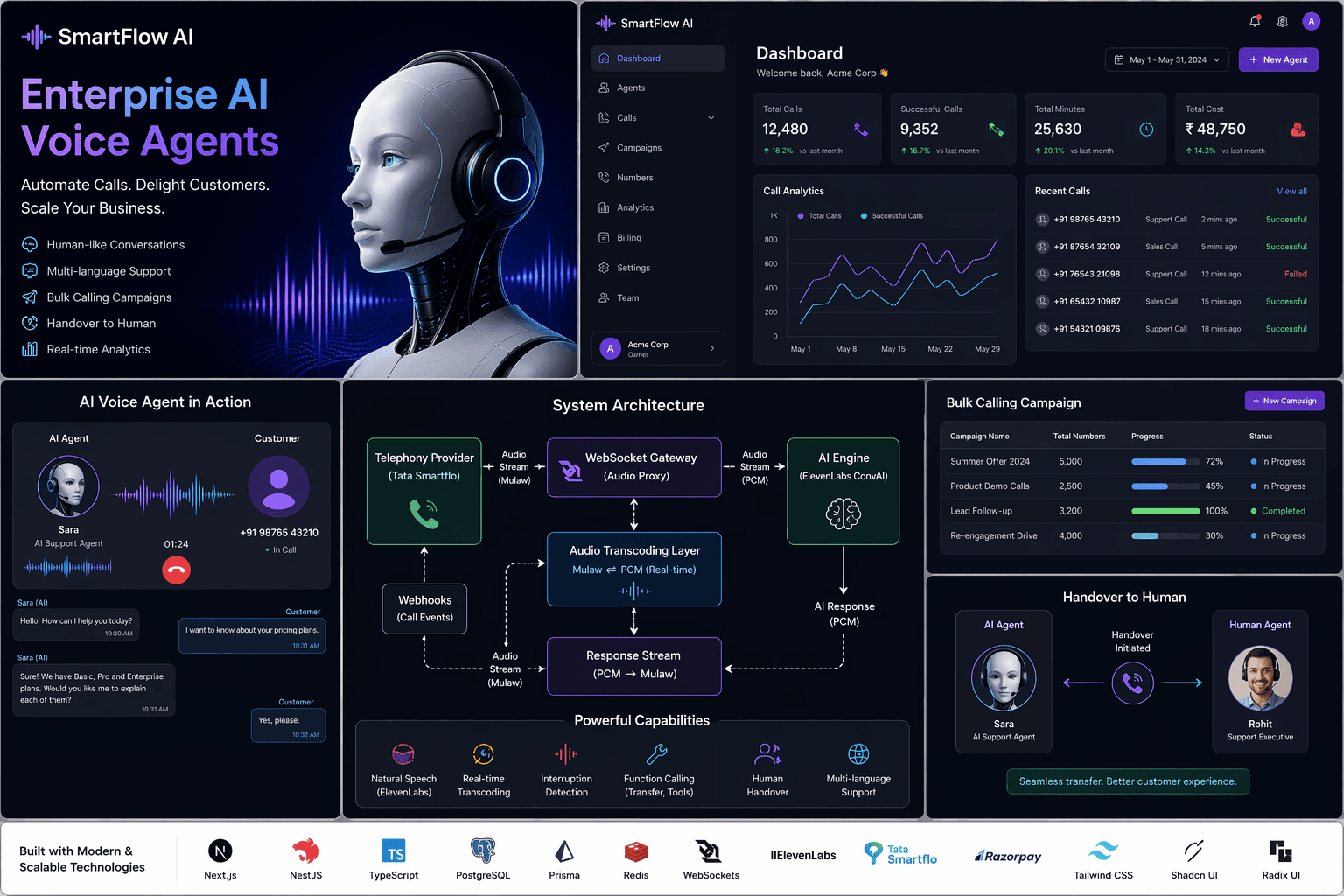
The Future of AI Calling Systems: How Voice Agents Are Transforming Business Communication
Discover how conversational AI, real-time telephony, and voice agents are transforming customer support, sales, and business automation.
Traditional call centers are evolving.
Businesses no longer want to rely only on large support teams, manual outbound calling, and expensive contact center operations. They want scalable, intelligent systems that can talk naturally, respond instantly, and operate 24/7.
That’s where AI Calling Systems are changing the game.
What Is an AI Calling System?
An AI Calling System uses conversational artificial intelligence, voice synthesis, telephony integrations, and real-time processing to automate phone conversations.
Unlike old IVR systems that force users through menus, modern AI voice agents can:
- Understand natural speech
- Hold human-like conversations
- Answer support questions
- Qualify leads
- Make outbound sales calls
- Schedule appointments
- Transfer calls to humans when needed
It feels less like talking to a bot and more like speaking with a trained agent.
Why Businesses Are Adopting AI Calling
1. 24/7 Customer Support
AI voice agents never sleep. Businesses can offer always-on support without increasing headcount.
2. Lower Operational Costs
AI calling systems can reduce:
- Support staffing costs
- Outbound call center expenses
- Lead qualification overhead
Some businesses report up to 70% lower support costs through automation.
3. Scalable Outbound Sales
- Bulk outreach campaigns
- Automated follow-ups
- Lead pre-qualification
- Human routing for hot leads
4. Human-Like Conversations
Modern AI voice systems use advanced speech models and LLMs to create natural conversations instead of robotic scripts.
- Intent understanding
- Interruption handling
- Context memory
- Multi-language support
- Emotional tone adaptation
Core Technologies Behind AI Calling Systems
Conversational AI
Large language models power intelligent dialogue for:
- Support automation
- FAQ handling
- Lead qualification
- Dynamic call flows
Voice Synthesis
Modern systems use realistic text-to-speech models that sound human.
- Better customer experience
- Higher engagement
- Reduced robotic interactions
Telephony Integration
- Inbound calling
- Outbound calling
- Call transfers
- Number provisioning
- Call event handling
Real-Time Audio Streaming
One of the hardest problems in AI calling is low latency.
Caller
↓
Telephony Provider
↓
WebSocket Audio Gateway
↓
Audio Transcoding Layer
↓
AI Engine
↓
Voice Response Stream
↓
Caller
This enables real-time conversations without noticeable delay.
Use Cases For AI Calling Systems
Customer Support
- Order status
- Account questions
- Troubleshooting
- Service requests
Sales Automation
- Cold calling prospects
- Lead qualification
- Demo booking
- Automated follow-ups
Appointment Scheduling
- Healthcare
- Education
- Consultations
- Service businesses
Debt Collection & Reminders
- Payment reminders
- Renewal calls
- EMI follow-ups
- Due notifications
Human + AI Collaboration
The future isn’t AI replacing humans.
It’s AI handling repetitive tasks while humans focus on complex conversations.
Human Handover
When needed, the AI can transfer a live call to a human agent.
- Escalations
- Angry customers
- High-value leads
- Complex support issues
Challenges In Building AI Calling Systems
Low Latency
Even 500ms delay can break conversation flow.
Audio Transcoding
- u-law
- PCM
- 8kHz / 16kHz conversions
Conversation State Management
- Context
- Interruptions
- Memory
- Tool calls
- Handover logic
Reliability at Scale
- Queues
- WebSockets
- Fault tolerance
- Monitoring
The Future of AI Calling
We’re moving from call centers to Smart Centers.
Future AI agents will support:
- Emotion detection
- Personalized conversations
- Autonomous task execution
- Voice commerce
- AI-operated support teams
This isn’t years away. It’s already happening.
Final Thoughts
AI calling systems are becoming a major shift in business automation.
They combine:
- Voice AI
- Telephony
- Automation
- Real-time infrastructure
- Human-like conversation
Companies adopting early gain:
- Lower costs
- Faster support
- Better customer experience
- Higher sales efficiency
The future of calling is intelligent, automated, and conversational.